

Quick Answer
Choose a semi-automatic vacuum packaging machine when you need lower initial investment, frequent product changeovers, flexible batch sizes, and direct operator control. Choose an automatic vacuum packaging system when your product flow is stable, daily volume is high, labor is a bottleneck, and vacuum sealing needs to connect with shrink and drying equipment.
The most important distinction: Within the framework of this guide, the term “semi-automatic” defines a complete workflow characterized by the following manual intervention: an operator undertakes pouch loading, positional adjustment, and lid manipulation or closure as required, before completing the unloading of the packaged product. Notably, the vacuum-and-seal cycle can still proceed in an automatic manner. This operational characteristic explains why commercial listings may classify the automation level of a chamber vacuum packaging machine as “automatic”, even though operator intervention remains a mandatory requirement for each production cycle.
Automatic vs. Semi-Automatic at a Glance
| Decision factor | Semi-automatic chamber machine | Automatic vacuum packaging system |
|---|---|---|
| Loading and unloading | Manual pouch handling at each cycle | Conveyorized or line-integrated product movement |
| Best production pattern | Small or medium batches; changing SKUs | Stable, repeatable, high-volume runs |
| Labor demand | Higher operator involvement | Lower handling per pack after loading is organized |
| Throughput | Depends strongly on operator rhythm | More consistent line flow and cycle timing |
| Changeover flexibility | Usually faster and simpler | More planning and setup may be required |
| Floor space and utilities | Lower | Higher; may require water, drainage, heat, and three-phase power |
| Initial investment | Lower | Higher, especially with shrink and drying modules |
| Typical fit | Restaurants, supermarkets, butcher shops, growing processors | Meat plants, seafood processors, central factories, export packing lines |
What Is an Automatic Vacuum Packaging System?
An automatic system is built around continuous product flow. Instead of stopping the process for an operator to load and unload a fixed chamber at every cycle, the product advances through a belt-type vacuum chamber and can continue to downstream finishing equipment. The main benefit is not simply a faster pump; it is a more repeatable production rhythm with fewer manual transfers.
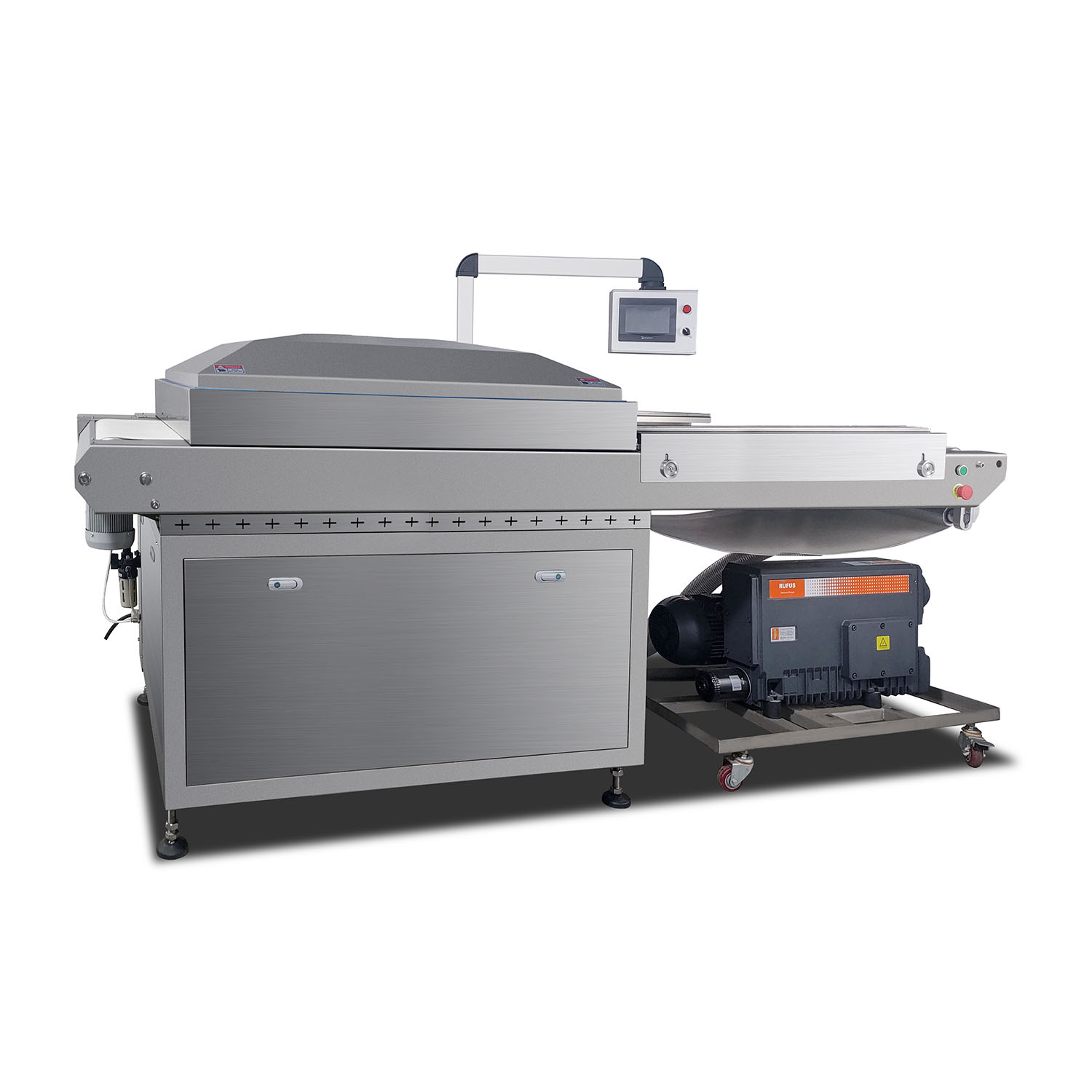
Representative DFPACK automatic belt vacuum chamber workflow
Automatic Reference: DZQ-800C/1000C
For this comparison, the DZQ-800C/1000C is the automatic vacuum packaging reference selected by Zhejiang Dongfeng Packing Machine Co., Ltd. It is intended for buyers evaluating a continuous belt-style vacuum and sealing stage for larger, more stable production. The exact chamber, sealing, pump, cycle, electrical, and layout specifications should be confirmed for the quoted configuration before publication or purchase.
A DZQ-800C/1000C-based system makes the most sense when upstream loading can feed products at a consistent rate and downstream handling is organized. It is especially relevant for processors packing repeatable cuts of meat, poultry, seafood, cheese, or other products in heat-shrinkable vacuum bags.
How the DZQ-800C/1000C Shrink-Packaging Line Can Be Configured
| 1 DZQ-800C/1000C Vacuum + seal | 2 ST-8031 or ST-10065 Hot-water shrink | 3 FG-1554 Inline drying | 4 Inspection / labeling Ready for secondary packing | |
|---|---|---|---|---|
| ST-8031 and ST-10065 are alternative shrink modules They should not automatically be presented as two mandatory hot-water machines in one straight line. ST-8031 is a hot-water dipping/shrink solution, while ST-10065 is the larger automatic hot-water shrink option for continuous flow. Engineering should choose the suitable shrink module—or a customer-specific arrangement—based on package size, output, utilities, and layout. FG-1554 can then dry the packs after shrink treatment. | ||||
ST-8031 Hot-Water Dipping Shrink Machine
ST-8031 uses hot water and an up-and-down lifting structure to shrink the vacuum bag closely around the product. DFPACK’s published page lists a 220-liter maximum water tank, a maximum load of 30 kg, stainless-steel construction, adjustable temperature and speed, and automatic water replenishment. It is a practical choice when a processor wants a controlled shrink stage without committing to the largest tunnel configuration.
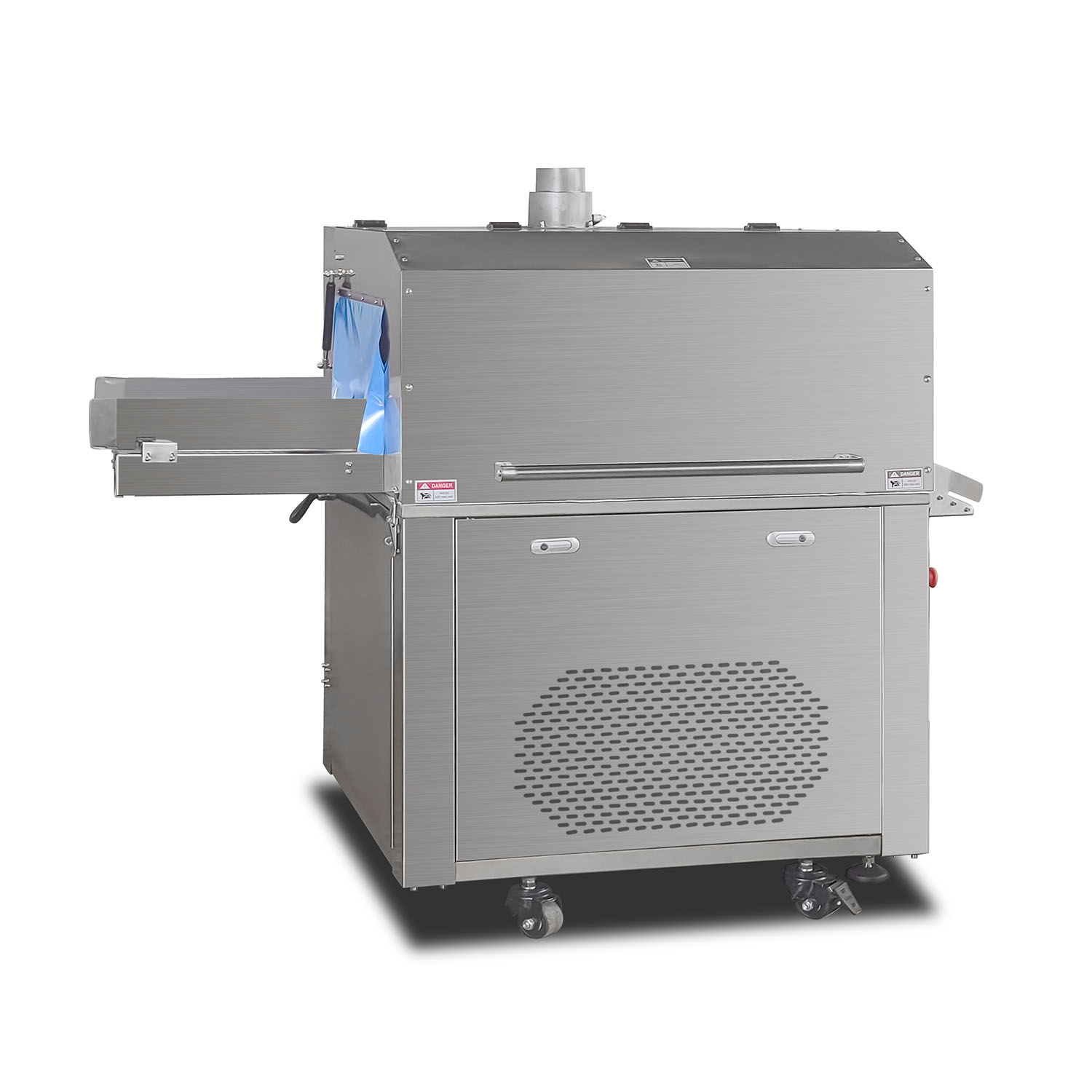
DFPACK ST-8031 hot-water dipping shrink machine
ST-10065 Automatic Hot-Water Shrink Machine
ST-10065 is suited to buyers who want an automatic hot-water shrink stage with a larger published package envelope. The official DFPACK page lists a maximum package size of 1000 × 650 × 250 mm, a maximum 220 liter water tank, and a maximum load of 30 kg. It is designed to support continuous handling after vacuum sealing; final throughput still depends on product size, bag, water temperature, conveyor settings, and the upstream machine.
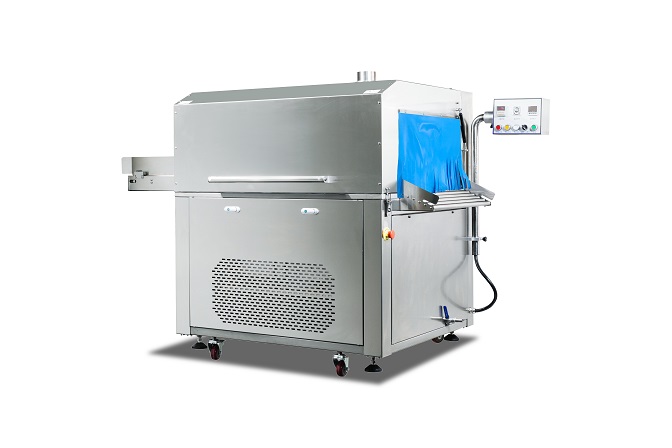
DFPACK ST-10065 automatic hot-water shrink machine
FG-1554 Automatic Inline Dryer
After hot-water shrink treatment, the pack surface is wet. FG-1554 provides an automatic inline drying stage so packs can move toward inspection, labeling, coding, weighing, or cartoning with less manual wiping. DFPACK’s official page lists adjustable conveyor speed from 0 to 10 m/min and describes height adjustment for different products. Published specifications should be reconfirmed for the final line configuration.
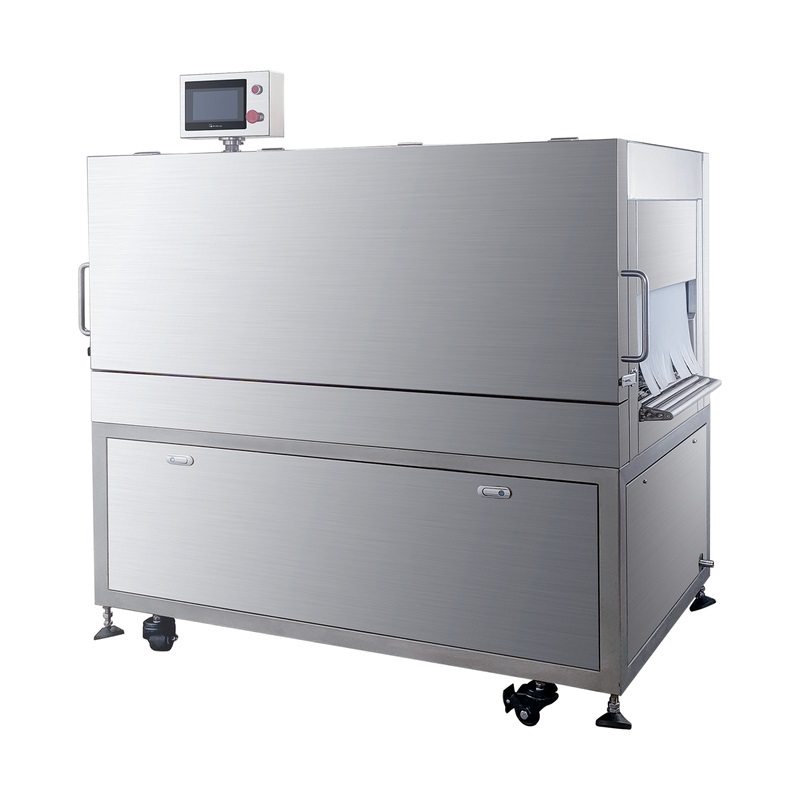
DFPACK FG-1554 automatic inline dryer tunnel
Advantages of an Automatic Vacuum Packaging Line
- More consistent product flow when pouch sizes and product formats are standardized.
- Less manual transfer between vacuum sealing, hot-water shrink treatment, and drying.
- Better potential for labor savings at high, sustained daily volume.
- Easier integration with inspection, weighing, labeling, coding, and secondary packaging.
- A cleaner route to capacity expansion when upstream and downstream processes are also organized.
Limitations to Plan For
- Higher initial investment and a larger installation footprint.
- More demanding utility planning, including electricity, water, drainage, ventilation, and possibly compressed air.
- Changeovers may take more planning when products and pouch sizes vary widely.
- A line can only run as efficiently as its slowest stage; loading, shrink, drying, inspection, and packing must be balanced.
- Maintenance skills, spare parts, cleaning access, and downtime procedures should be agreed before commissioning.
What Is a Semi-Automatic Vacuum Packaging Machine?
A semi-automatic chamber machine automates the vacuum, sealing, cooling, and air-return cycle after the operator positions the pouch. The operator still loads and unloads each pack and may move the lid or swing it between chambers. This combination keeps the equipment straightforward while allowing a processor to change products, bag sizes, and batch quantities quickly.
Tabletop Chamber Machines: Flexible Entry-Level Production
A tabletop chamber vacuum sealer such as the DFPACK DZ-300T series is appropriate for restaurants, supermarkets, wet markets, butcher shops, test kitchens, and specialty producers. It occupies limited counter space and gives the operator direct control over small batches. The tradeoff is a smaller chamber and greater handling time per pack.

DFPACK DZ-300T tabletop chamber vacuum packaging machine
Single-Chamber Floor Models: More Space, Simple Workflow
A floor-standing single-chamber model is the next step when products or pouches no longer fit a tabletop chamber. It suits central kitchens, seafood packers, agricultural-product businesses, and growing factories that need a longer seal or deeper chamber but still value a compact, easy-to-understand process. One operator normally loads the chamber, starts or closes the lid as designed, waits for the cycle, and unloads the finished pack.
Double-Chamber Machines: Higher Output Without a Full Automatic Line
Double-chamber machines such as the DFPACK DZQ-400/500/600 2SA series are often the best middle ground for a growing food processor. While one chamber completes the programmed cycle, the operator can arrange pouches on the other side. This overlapping work reduces idle time without adding a complete conveyorized line.
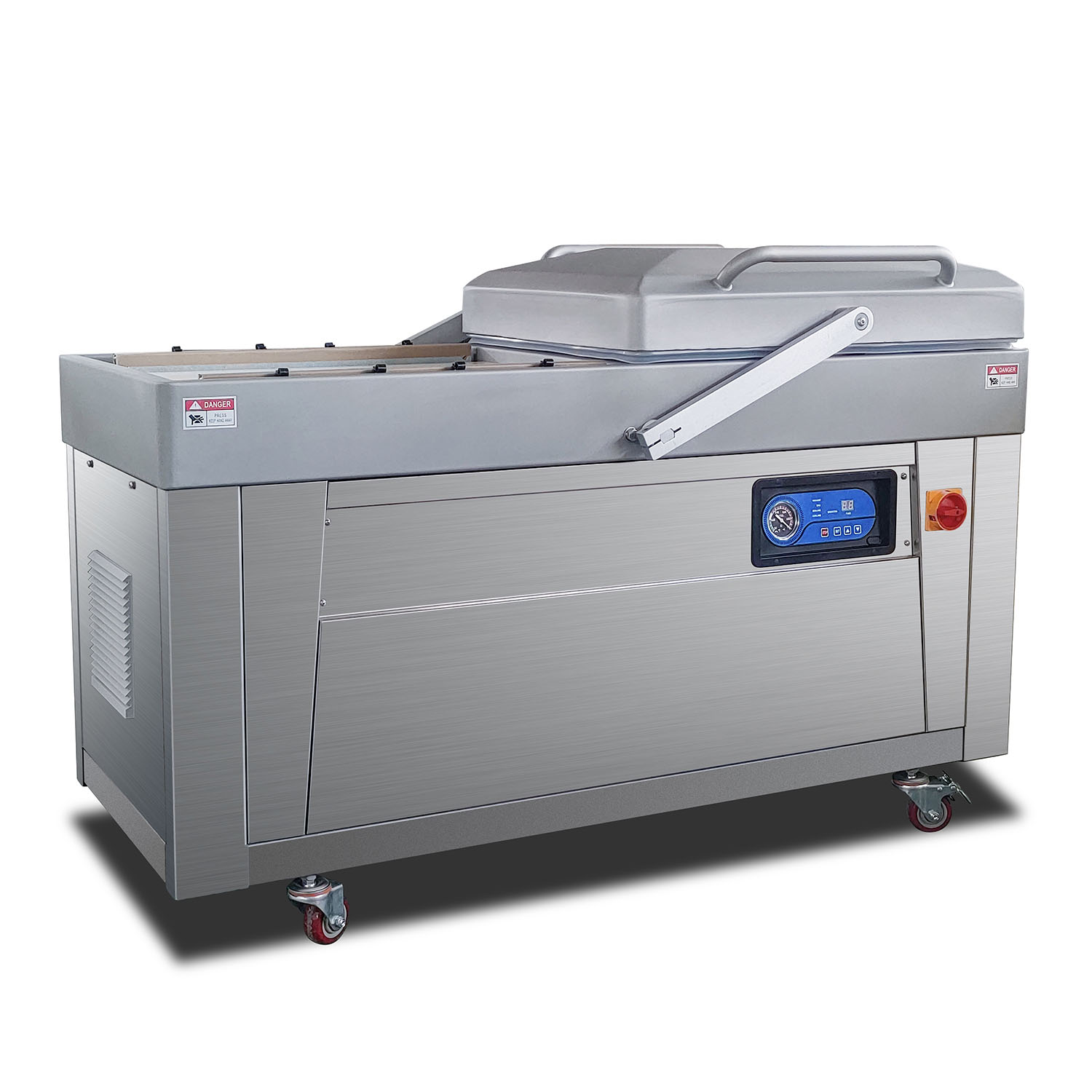
DFPACK double-chamber vacuum packaging machine
The series is useful for meat, seafood, prepared food, agricultural products, powders, granules, and industrial parts when the pouch and product are compatible with chamber vacuum packaging. Larger DZQ double-chamber configurations can also support large cuts or multiple pouches per cycle. The correct model should be selected from the filled pouch dimensions, required seal length, product height, pump configuration, and target packs per hour.
Advantages of Semi-Automatic Chamber Machines
- Lower capital requirement than a complete automatic line.
- Quick adaptation to new products, pouch sizes, and short production runs.
- Simpler installation and a smaller footprint.
- Operators can visually check product placement before every cycle.
- A double-chamber model can provide substantial output while keeping the workflow flexible.
Limitations to Plan For
- Output depends on operator speed, training, fatigue, and pouch preparation.
- Manual lifting and repetitive handling may become a bottleneck as volume grows.
- Uneven loading rhythm can create queues before or after the machine.
- Adding shrink treatment and drying as separate manual steps increases handling.
Which Machine Should You Choose?
Choose an Automatic System If…
- You run stable, repeatable products for long shifts.
- Your current bottleneck is labor or manual movement between process stages.
- You need vacuum sealing, hot-water shrink treatment, and drying in one coordinated workflow.
- You have sufficient floor space, utilities, maintenance support, and installation planning.
- The expected labor and output gains justify the higher total investment.
Choose a Semi-Automatic Machine If…
- You package small or medium batches, seasonal products, or many SKUs.
- Demand is still growing and you want to protect cash flow.
- Operators need to adjust product placement from pack to pack.
- Available floor space or electrical capacity is limited.
- You want to scale from tabletop to single chamber or double chamber in stages.
Use Output per Labor Hour—not the Machine Label
Do not decide from the words ‘automatic’ or ‘semi-automatic’ alone. Compare good packs per labor hour. Count pouch loading, product positioning, lid movement, cycle time, unloading, shrink treatment, drying, inspection, rework, and changeover. A well-organized double-chamber station can outperform a poorly balanced automatic line, while a properly designed automatic line can create significant savings at sustained volume.
A Simple ROI Calculation
Annual operating benefit: (Labor hours saved × fully loaded hourly labor cost) + value of extra sellable output + reduced rework or handling losses − additional utilities − annual maintenance.
Divide the additional investment in the automatic system by the estimated annual operating benefit to calculate a simple payback period. Use conservative assumptions and include realistic utilization: an automatic line scheduled for only a few short batches may not deliver the expected return.
Information to Send Before Requesting a Recommendation
A useful quotation starts with the application, not only the model number. Send:
- Product name, dimensions, unit weight, temperature, and clear photos or video.
- Filled pouch width, length, thickness, material, and shrink-bag requirement.
- Current and target packs per minute or packs per hour, plus working hours per day.
- Number of SKUs, typical batch size, and changeover frequency.
- Available voltage, phase, frequency, water, drainage, compressed air, and floor space.
- Required downstream steps: shrink, drying, weighing, inspection, labeling, coding, or cartoning.
- Destination, preferred Incoterm, installation expectations, and desired spare-parts package.
Recommended Selection Process
- Run a sample-pack test with the actual product and pouch.
- Confirm usable chamber dimensions and sealing position from the filled pouch—not the empty bag.
- Measure the complete workflow and identify the real bottleneck.
- Ask for a line layout showing operators, product direction, utilities, cleaning access, and maintenance space.
- Confirm final specifications, included components, warranty, training, spare parts, and acceptance criteria in writing.
Frequently Asked Questions
Is a double-chamber vacuum packaging machine automatic or semi-automatic?
The vacuum-and-seal cycle is usually automatic after activation, but the overall workflow is commonly semi-automatic because an operator loads and unloads pouches and moves the lid between chambers. Always check what the supplier means by ‘automatic grade.’
When should a food factory move from double chamber to an automatic belt machine?
Consider the change when demand is stable, manual handling limits output, production runs are long enough to justify setup, and downstream shrink or drying stages can be balanced with the vacuum machine. A time study and ROI calculation are more reliable than a fixed packs-per-day rule.
Do ST-8031 and ST-10065 need to be installed together?
Not necessarily. They are hot-water shrink solutions for different workflow requirements. The correct shrink module should be selected according to package size, output, utilities, layout, and the desired level of line integration. Confirm the final arrangement with DFPACK engineering.
What does FG-1554 do after vacuum shrink packaging?
FG-1554 is an inline drying tunnel. It removes surface water after hot-water shrink treatment so packs can proceed more efficiently to inspection, weighing, labeling, coding, or secondary packaging.
Is an automatic vacuum packaging line always faster?
It can deliver a more consistent and higher-capacity workflow, but only when loading, vacuum sealing, shrink treatment, drying, inspection, and unloading are balanced. A bottleneck at any stage reduces total line output.
Can DFPACK customize a vacuum packaging system?
DFPACK states that it provides customized packaging machinery solutions. Provide product, pouch, capacity, utility, and layout information so the technical team can recommend a suitable chamber machine or integrated line.
Get a Vacuum Packaging Line Recommendation
The right choice depends on your production pattern. Semi-automatic chamber machines protect flexibility and investment; automatic systems reduce handling and create a more consistent flow at sustained volume. Zhejiang Dongfeng Packing Machine Co., Ltd. can evaluate your product, pouch, output target, utilities, and floor plan before recommending a DZQ chamber machine or a DZQ-800C/1000C-based vacuum, shrink, and drying solution.