

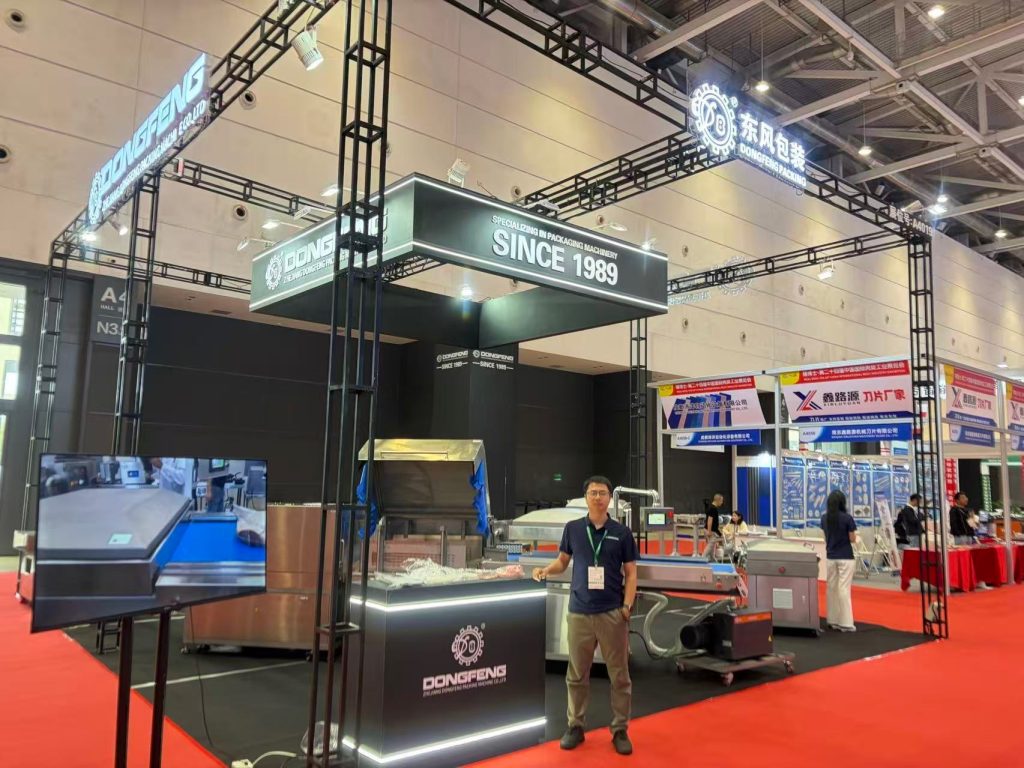
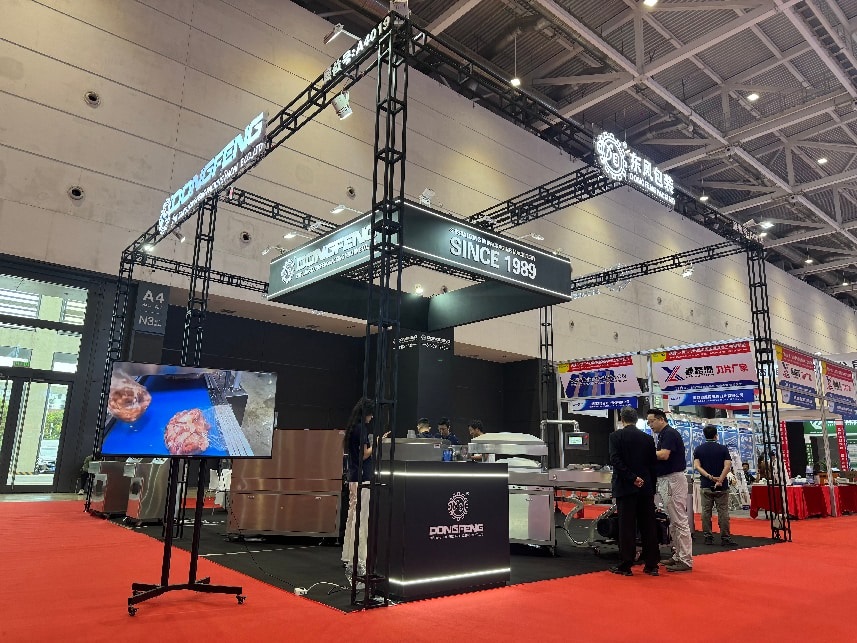
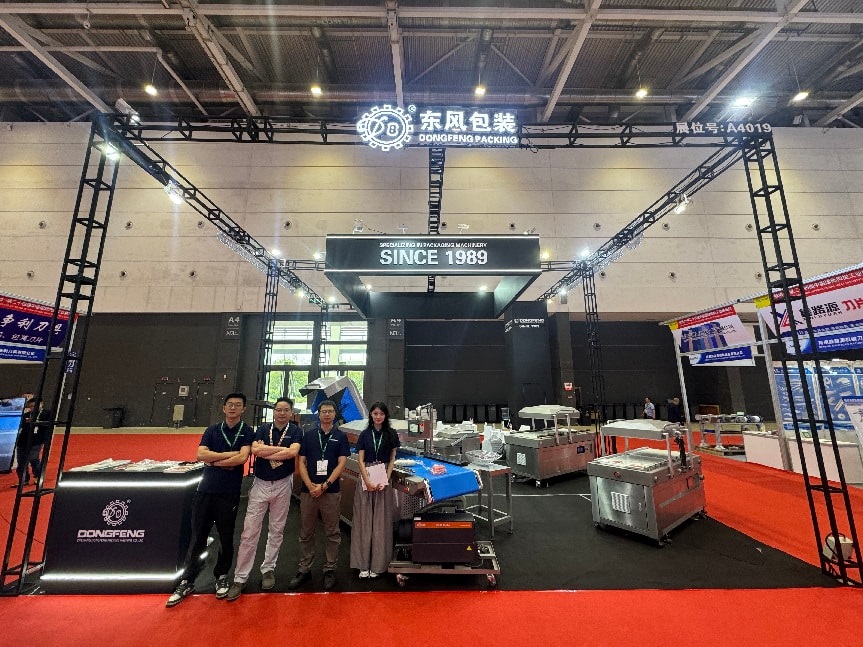
I recently attended the 24th China International Meat Industry Exhibition, CIMIE 2026, representing Zhejiang Dongfeng Packing Machine Co., Ltd.
For me, one of the most valuable parts of the exhibition was speaking directly with people who use vacuum packaging equipment and meat packaging machines in daily production. Many of the Chinese visitors I met came with specific applications from their own factories, including pork, chicken portions, whole chickens, and duck products.
I also met overseas vacuum packaging machine distributors. They brought questions about the meat packaging challenges their customers face, creating an opportunity to exchange practical ideas across different markets.
These conversations reinforced a simple point: effective meat vacuum packaging starts with understanding the product, the required output, and the factory’s workflow.
Connecting with Chinese Meat and Poultry Processors
Many domestic visitors were evaluating meat packaging equipment in the context of an existing production process. Their interest was closely connected to the products they handle every day.
Although pork, chicken, and duck may all be packed using vacuum packaging equipment, they do not necessarily have the same packaging requirements. Product dimensions, bag sizes, bone content, and the way operators load each package can all affect equipment selection.For a factory handling several product types, the first step is to define the full range of packages the machine needs to accommodate. Selecting equipment around only the smallest or most regular product can overlook the demands of larger or less uniform items.
Vacuum Packaging for Pork and Chicken Portions
For pork cuts and chicken portions, it is useful to look beyond the machine’s external dimensions and consider how the filled bags will fit inside the chamber.
The usable chamber space, sealing bar arrangement, and bag opening position all matter. A machine should allow operators to place packages correctly without crowding the sealing area.
When evaluating a vacuum packaging machine for meat, processors should prepare information such as:
The smallest and largest filled package dimensions.
The weight range of each product.
Whether the products contain bones.
The vacuum bag material and dimensions.
The required output per hour.
The available space and loading arrangement.
This gives a supplier a more useful starting point than a general request for a “high-capacity vacuum machine.”
Whole Chicken and Duck Packaging Requires Attention to Shape
Whole chickens and ducks present a different selection challenge because their shape and height are less uniform than those of flat portions.
A chamber may appear large enough when comparing length and width, but the height of the filled package also needs to be checked. Operators need enough room to load the product and position the bag opening properly for sealing.
Bag selection is another part of the assessment. Where products have protruding bones or irregular edges, the packaging material and loading method should be evaluated together.
For whole poultry applications, a trial with representative products and the intended vacuum bags is a practical way to assess package fit, sealing results, and handling before confirming the equipment configuration.
Exchanging Ideas with Overseas Vacuum Machine Distributors
Meeting overseas distributors added another perspective to the exhibition.
These visitors were considering the packaging difficulties experienced by their own meat-processing customers. Our exchanges highlighted the value of sharing clear application details between the end user, distributor, and equipment supplier.
For distributors, a useful inquiry should include more than a product name. Photos of the filled bags, package dimensions, required output, and details of the existing production process help make the technical discussion more specific.
The same approach is helpful when discussing service requirements. Electrical supply, operator training, routine maintenance, and spare parts should be considered alongside the machine itself.
Matching Output to the Actual Working Process
Production capacity is an important part of machine selection, but it needs to be understood in practical terms.
A stated machine cycle does not describe every step in a factory’s packaging process. Bag preparation, loading, positioning, unloading, and product changes also take time.
For this reason, a meaningful capacity assessment should consider the number of packages that fit into each cycle and the way operators will work around the equipment.
Factories should also distinguish between average daily requirements and peak production periods. Sharing both figures helps identify the operating flexibility needed for the application.
What I Took Away from CIMIE 2026
My main takeaway from CIMIE 2026 was the importance of application-specific communication.
Chinese processors and overseas distributors approached us from different backgrounds, but their questions were connected by a common objective: finding meat packaging machines and poultry packaging equipment that fit real production needs.
For me, those conversations were the most useful part of attending the exhibition. They provided a closer understanding of the products customers are packaging and the details that matter when evaluating a machine.
Thank you to everyone who visited the DONGFENG booth and shared their experience.
Discuss Your Meat Vacuum Packaging Application
If you are selecting meat packaging equipment, including a vacuum packaging machine for pork, chicken portions, whole chickens, or duck products, please contact Zhejiang Dongfeng Packing Machine Co., Ltd.
Share your product photos, filled bag dimensions, required hourly output, electrical supply, and available installation space. These details provide the starting point for discussing a suitable equipment configuration.
If you met us at CIMIE in the further, I would be pleased to continue our conversation.