

Why Food Manufacturers Upgrade to Automatic Packaging Machines In Europe
For food manufacturers supplying European meat markets, upgrading to automatic packaging is not only about speed. It is about producing the same quality pack across every batch, shift, and delivery.
Supermarket buyers expect clean seals, readable labels, reliable traceability, suitable cold-chain protection, and consistent presentation. As volumes increase, manual handling can create variation in bag positioning, sealing, labelling, and batch control. Automation helps turn these repeated steps into a more stable process.
For vacuum-packed meat products, a typical workflow may include vacuum packaging, hot-water shrinking, and surface-water removal. DongFeng’s DZQ-800C, ST-10065, and FG-1554 correspond to these three stages.
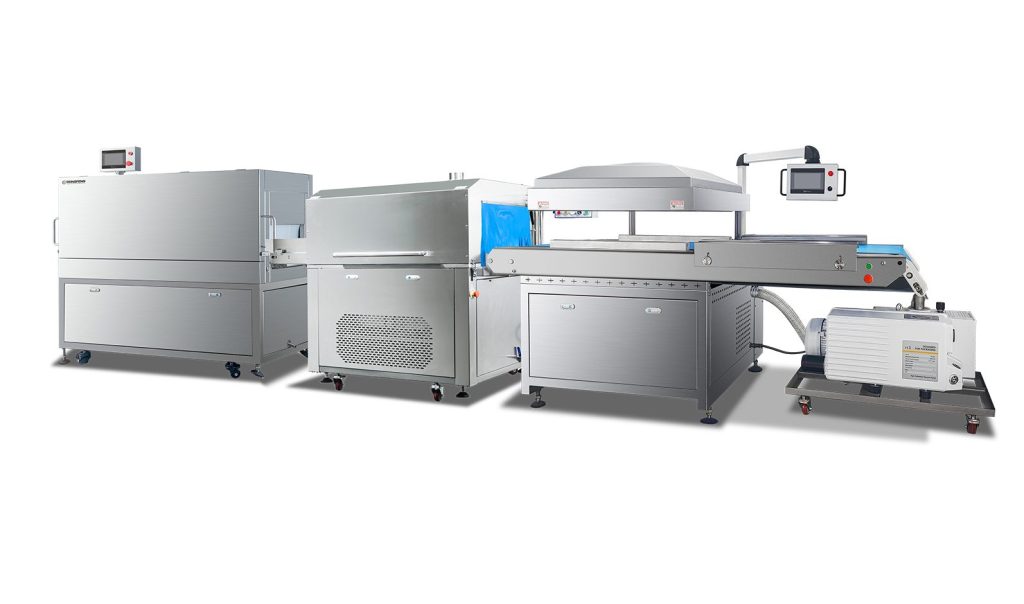
Typical vacuum packaging, hot-water shrinking, and air-drying line concept. Final layout depends on the product, package size, target output, and available space.
European Supermarkets Buy Consistency, Not Just Capacity
A supermarket or private-label buyer wants to know whether a supplier can maintain the same standard during normal production, not only during a sample run.
The practical questions are simple:
- Are seals clean and consistent?
- Are the correct labels and date codes applied?
- Can each batch be traced quickly?
- Will packs remain suitable for chilled transport?
- Can the factory repeat orders without adding uncontrolled manual steps?
Semi-automatic equipment remains useful for small batches, specialist products, and frequent format changes. For stable, higher-volume production, an automatic system can reduce repeated handling and make process control easier.
The Meat Packaging Requirements That Matter in Europe
Labels, Codes, and Traceability
EU food labelling rules generally require information such as the product name, ingredients, allergens where applicable, net quantity, date marking, storage conditions, food business operator details, and nutrition information. Origin information is also important for certain fresh, chilled, and frozen meats.
The packaging machine does not decide whether a label is legally correct. That remains the responsibility of the food business operator. The equipment can, however, support a controlled workflow linking the product, label, date code, and batch record.
Traceability should connect raw materials, production runs, labels, finished packs, customers, and dispatch records. This allows the factory to identify affected products quickly if a retailer requests a withdrawal.
Sealing, Shrinking, and Pack Protection
A poor seal can cause leaks, damage presentation, shorten the intended shelf life, and increase waste. Packaging performance depends on the product, bag material, product temperature, machine settings, and handling conditions.
Automatic equipment can make vacuum, sealing, shrinking, and transfer steps more repeatable. It cannot guarantee shelf life or compliance by itself. The complete combination of product, packaging material, machine settings, storage temperature, and distribution conditions must be validated.
DZQ-800C: The Vacuum Packaging Stage
The DZQ-800C Chamber Belt Vacuum Packing Machine combines chamber vacuum packaging with belt feeding for a more continuous production flow.
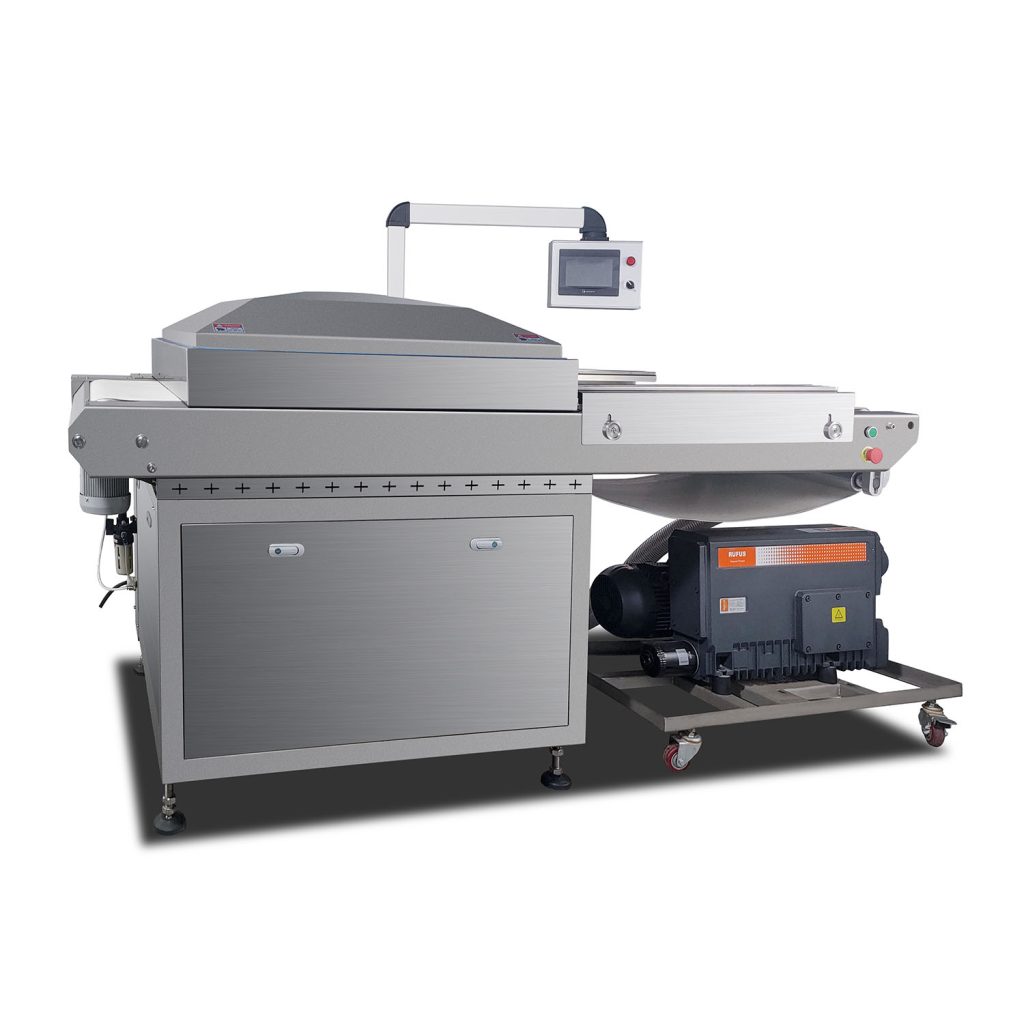
The official product page lists the DZQ-800C with:
- 800 × 10 mm sealing bar
- 200 m³/h vacuum pump
- 20–40 second cycle time
- Stainless-steel construction
The page also describes options including gas flushing, soft air, pump dust filtration, pump self-cleaning, PLC control, and a quick-release conveyor belt. These options should be confirmed in the final quotation.
Published ST-10065 information includes:
- 36 kW configuration
- 1040 × 825 × 500 mm water tank
- 1988 × 1216 × 1455 mm machine dimensions
- Automatic hot-water shrink process
- 304 stainless-steel construction
- Siemens PLC, Schneider Electric, and SEW options
The correct water temperature, immersion time, bag material, and loading conditions should be confirmed through product trials.
ST-10065: The Hot-Water Shrink Stage
After vacuum sealing, some meat products require hot-water shrinking to improve the fit and appearance of the bag. DongFeng’s ST-10065 Hot Water Shrink Tunnel is designed for higher-volume shrink packaging lines.
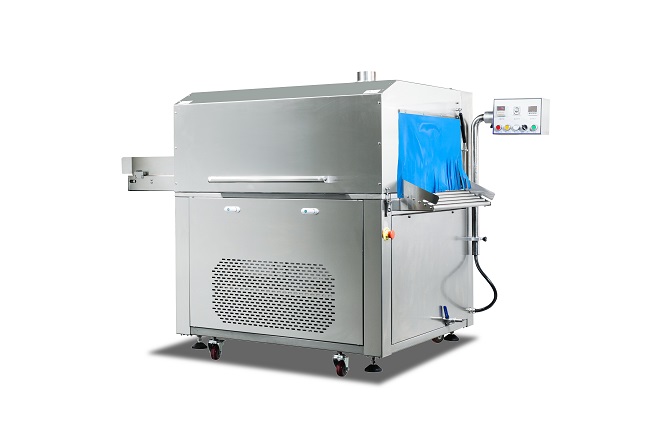
Published ST-10065 information includes:
- 36 kW configuration
- 1040 × 825 × 500 mm water tank
- 1988 × 1216 × 1455 mm machine dimensions
- Automatic hot-water shrink process
- 304 stainless-steel construction
- Siemens PLC, Schneider Electric, and SEW options
The correct water temperature, immersion time, bag material, and loading conditions should be confirmed through product trials.
FG-1554: The Surface-Water Removal Stag
Hot-water shrinking leaves moisture on the outside of the pack. The FG-1554 Air Drying Machine is used as an inline surface-water removal stage before inspection, coding, labelling, boxing, or cold storage.
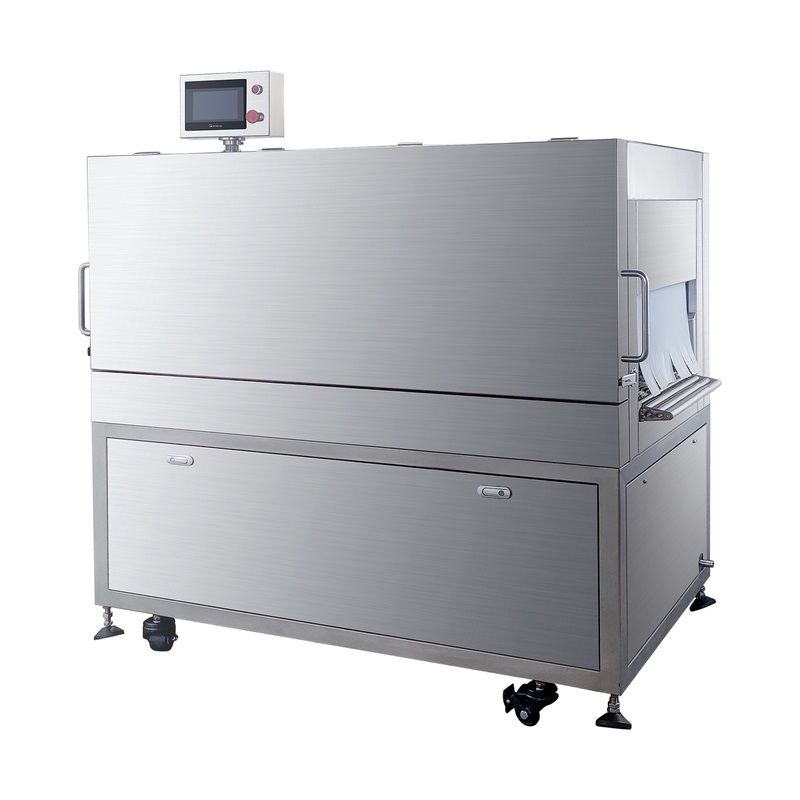
DongFeng’s published production-line material describes FG-1554 as an automatic inline dryer with adjustable conveyor speed and height adjustment. The final configuration should be confirmed according to the pack size, product weight, conveyor speed, outlet height, drainage, and downstream equipment.
Why Automatic Packaging Supports Supermarket Entry
More Consistent Packs
A vacuum-shrink-drying sequence can improve finished-pack consistency:
- DZQ-800C removes air and seals the bag.
- ST-10065 tightens the compatible shrink bag around the product.
- FG-1554 removes surface water before downstream handling.
This helps reduce variation in seal position, pack shape, loose film, and wet outer surfaces.
Fewer Repetitive Handling Errors
Automation does not remove the need for operators. It changes their role from repeatedly carrying products between separate stations to monitoring a coordinated process and checking quality at defined points.
A Smoother Chilled-Chain Workflow
A connected vacuum, shrink, and drying process can reduce manual transfer before inspection, boxing, or cold storage. The three stages must still be balanced. If the vacuum machine runs faster than the shrink tunnel or dryer, packs will accumulate between stations.
Easier Scaling for Retail Orders
Automatic packaging gives manufacturers a more scalable platform as order quantities increase. The correct investment should be based on complete line capacity, including loading, vacuum packaging, shrinking, drying, inspection, and dispatch—not on the headline speed of one machine.
Packaging Sustainability Is a Commercial Issue
European retailers are paying more attention to material use, recyclability, and packaging waste. For meat processors, reducing material cannot come at the expense of product protection or seal quality.
When changing bags or shrink film, manufacturers should test the complete combination of product, material, machine settings, shrink appearance, shelf-life target, and chilled distribution conditions. Automatic equipment can improve process consistency, but it does not make a packaging material compliant by itself.
What Large Retail Buyers Want to See
Before approaching a major supermarket, a meat manufacturer should be able to demonstrate:
- Stable sealing quality during normal production
- Packaging materials suitable for the product and storage conditions
- Accurate labels, date codes, and batch identification
- Traceability from raw material through dispatch
- Controlled label and batch change procedures
- Records for seal checks, cleaning, maintenance, and corrective actions
- Enough capacity to repeat orders without reducing pack quality
- Food-safety and supplier-assurance systems required by the customer
Choosing the Right Automatic Packaging Upgrade
The best machine is not always the one with the highest advertised output. Ask whether the system can produce the required pack format, seal quality, coding accuracy, and daily volume under actual factory conditions.
For the DZQ-800C, confirm bag dimensions, sealing length, pump configuration, cycle settings, gas-flushing requirements, and conveyor layout. For the ST-10065, confirm bag material, product size, utilities, electrical configuration, and target shrink finish. For the FG-1554, confirm the post-shrink pack size, conveyor speed, dryer height, surface-water target, and downstream connection.
A product trial with the actual meat product and packaging material is more useful than comparing catalogue figures alone.
The Upgrade Is Really About Retail Confidence
Automatic packaging is an investment in repeatability. For meat processors entering European retail channels, the DZQ-800C, ST-10065, and FG-1554 can create a more orderly process for suitable vacuum-shrink packaging applications:
vacuum packaging → hot-water shrinking → surface-water removal
The final result depends on product compatibility, packaging material, equipment configuration, and validation under real production conditions.
Talk to Our Packaging Team
If you are planning to upgrade from semi-automatic packing to an automatic vacuum packaging line, Zhejiang DongFeng Packing Machine Co., Ltd. can evaluate a suitable configuration based on your product, pack format, target output, utilities, and factory layout.