

Selecting a vacuum pump starts with the process. The pump must evacuate the chamber within the required cycle time, reach the working vacuum, tolerate the product load and remain reliable over the planned operating schedule. A larger nominal capacity is not automatically a better choice: an oversized pump can add motor power, heat and cost without improving the package.
1. Information required before choosing a pump
Record the following before asking for a quotation:
- Chamber volume and the volume occupied by the product or bag
- Required cycle time and cycles per hour
- Working vacuum and the required residual oxygen level
- Product moisture, water vapour, powder or other contamination
- Intermittent, two-shift or continuous operation
- Voltage, frequency, installation space, pipe size and service conditions
The same pump capacity can perform differently on two machines. Pipe length, valves, fittings, leakage and chamber sealing all affect the effective evacuation rate. For a multi-machine installation, calculate simultaneous demand rather than adding the nameplate capacities without checking the operating sequence.
2. How to read the key specifications
Pumping speed
Pumping speed is normally stated in m³/h. It is a nominal reference measured under defined conditions, not a promise of a particular cycle time. Ask for the pumping-speed curve at the pressure used by the machine. Compare suppliers at the same frequency, pressure and measurement method.
Ultimate pressure
Ultimate pressure indicates the lowest pressure obtained under a specified test condition. It helps to compare the depth of vacuum, but it does not describe how quickly the pump reaches that pressure. Chamber volume, gas load and moisture must be considered at the same time.
Moisture and gas ballast
Meat, fish, seafood and cheese can release water vapour during evacuation. In an oil-lubricated rotary-vane pump, condensation may dilute the oil and affect lubrication. A gas-ballast valve introduces a controlled amount of ambient air during compression to reduce vapour condensation. With gas ballast open, the attainable ultimate pressure is normally higher, so the setting must follow the process requirements.
Where the vapour load is high, discuss a moisture-resistant or Aqua configuration, pre-separation, or a liquid-ring pump with the manufacturer. These are engineering options, not universal features of every pump.
Intermittent and continuous duty
Tabletop machines often run short cycles with pauses. Industrial lines may operate for many hours. Continuous-duty selection should include the motor rating, cooling method, oil capacity, exhaust filtration and maintenance access. A pump suitable for intermittent packaging should not be transferred to a central 24-hour system without a duty check.
3. Capacity guide for vacuum packaging
| Reference capacity | Typical use | Main checks |
|---|---|---|
| 5 m³/h | Small tabletop equipment and low-volume packaging | Cycle time, moisture load and compact installation |
| 8 m³/h | Small restaurant, retail and light food packaging | Intermittent-duty rating and filter access |
| 20 m³/h | Small chamber machines and higher-frequency tabletop equipment | Gas ballast, cooling and oil mist separation |
| 40 m³/h | Medium single-chamber machines and commercial packaging | 50/60 Hz data, motor power and inlet size |
| 65 m³/h | Large single-chamber or medium double-chamber machines | Whether the actual rating is 63, 65 or 76 m³/h |
| 100 m³/h | Large double-chamber machines and high-output packaging | Evacuation time, continuous duty and oil capacity |
| 200 m³/h | Industrial packaging lines and central vacuum systems | Pipe losses, simultaneous demand and electrical supply |
| 300 m³/h | Large chambers and high-volume production lines | Heat dissipation, controls and possible booster systems |
These classes are starting points. A final model should be selected from the chamber calculation and the pump curve, not from the rounded capacity alone.
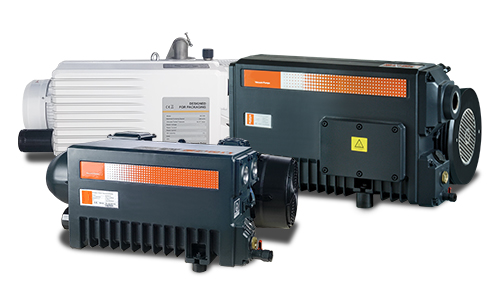
4. Busch and domestic/XD capacity comparison
The supplied reference image lists common domestic/XD oil-lubricated rotary-vane pump sizes of 10, 20, 25, 40, 63, 80, 100, 160, 200, 250 and 300 m³/h. These figures are treated here as market reference sizes. They are not a complete official catalogue for one Chinese manufacturer. The exact domestic model must be checked for motor power, ultimate pressure, frequency, gas-ballast performance, dimensions and maintenance requirements.
Domestic/XD market size | Busch reference | Busch published capacity | How to use the comparison |
|---|---|---|---|
| 10 m³/h | R5 KB 0010/0016 E or R5 RA/RC 0010/0016 C | About 10–19 m³/h depending on series | Nearby compact ranges; check ultimate pressure because the series are not equivalent. |
| 20 m³/h | R5 KD 0012/0020 A or R5 KB 0020–0040 D/F | 10–20 m³/h or 20–48 m³/h | Reference for small chamber and tabletop equipment. |
| 25 m³/h | R5 KD 0025 A | 22–25 m³/h | Close compact reference; compare actual working pressure. |
| 40 m³/h | R5 RA 0040 F | 40 m³/h at 50 Hz and 48 m³/h at 60 Hz | Direct Busch reference for the 40 m³/h class. |
| 63–65 m³/h | R5 RA 0063 F | 63 m³/h at 50 Hz and 76 m³/h at 60 Hz | Closest verified Busch reference to a market 65 m³/h label. |
| 80 m³/h | R5 RA 0063 F or R5 RA 0100 F | 76 m³/h at 60 Hz or 100 m³/h at 50 Hz | No exact 80 m³/h Busch model was confirmed in the sources checked; use the curve and cycle requirement. |
| 100 m³/h | R5 RA 0100 F | 100 m³/h at 50 Hz and 120 m³/h at 60 Hz | Direct Busch reference for the 100 m³/h class. |
| 160 m³/h | R5 RA 0165 D or R5 RD 0200 A | 160 m³/h at 50 Hz | Direct capacity reference; the two series have different designs and motor data. |
| 200 m³/h | R5 RA 0205 D or R5 RD 0240 A | 200 m³/h at 50 Hz | Compare energy use, motor power, duty and maintenance design. |
| 250 m³/h | R5 RA 0255 D or R5 RD 0300 A | 250 m³/h at 50 Hz | Confirm pipe size, electrical supply and continuous-duty requirements. |
| 300 m³/h | R5 RA 0305 D or R5 RD 0360 A | 300 m³/h at 50 Hz | Reference class for large industrial and central systems. |
Frequency must be stated beside every capacity. For example, Busch lists R5 RA 0063 F at 63 m³/h at 50 Hz and 76 m³/h at 60 Hz; R5 RA 0100 F is listed at 100 m³/h at 50 Hz and 120 m³/h at 60 Hz. A domestic pump marked 63, 65, 80 or 100 m³/h should be compared under the same frequency and test condition.
5. Busch reference data
| Busch model | Nominal pumping speed | Ultimate pressure reference | Other published data |
|---|---|---|---|
| R5 PB 0004/0008 C | 4.0–9.6 m³/h | Approx. 2.0 hPa | Compact oil-lubricated rotary-vane pump |
| R5 KD 0012/0020 A | 10–20 m³/h | Approx. 2.0 hPa | Compact tabletop packaging reference |
| R5 RA 0040 F | 40 / 48 m³/h at 50 / 60 Hz | 0.1–0.5 hPa closed; 0.5–1.5 hPa open | 1.4 / 1.7 kW motor rating; 1.0 L oil capacity |
| R5 RA 0063 F | 63 / 76 m³/h at 50 / 60 Hz | 0.1–0.5 hPa closed; 0.5–1.5 hPa open | 2.0 / 2.4 kW; 2.0 L oil capacity; approx. 55 kg |
| R5 RA 0100 F | 100 / 120 m³/h at 50 / 60 Hz | 0.1–0.5 hPa closed; 0.5–1.5 hPa open | 2.7 / 3.4 kW; 2.0 L oil capacity; approx. 75 kg |
| R5 RA 0205 D | 200 / 240 m³/h at 50 / 60 Hz | 0.1 hPa closed; 0.5 hPa open | 5.5 / 6.6 kW standard motor; 6.5 L oil capacity; approx. 160 kg |
| R5 RA 0305 D | 300 / 360 m³/h at 50 / 60 Hz | 0.1 hPa closed; 0.5 hPa open | 8.3 / 10.0 kW standard motor; 6.5 L oil capacity; approx. 195 kg |
| R5 RD 0240 A | 200 m³/h | 0.1 hPa closed; 0.5 hPa open | 4.0 kW motor rating; R5 RD packaging and continuous-duty reference |
| R5 RD 0360 A | 300 m³/h | 0.1 hPa closed; 0.5 hPa open | 5.5 kW motor rating; large industrial reference |
The table is a capacity and specification reference, not a claim that Busch and domestic pumps with the same m³/h are equivalent. The final comparison must include the working-pressure curve, moisture handling, energy use, noise, filters, oil and service support.
6. Filtering, cleaning and maintenance
Dust protection at the inlet
An inlet filter protects the pump from dust and solid particles in the process gas. The Busch R5 RA 0165–0305 D instruction manual describes a paper or polyester inlet-filter cartridge and recommends a suitable upstream filter of 5 microns or less when the ordered configuration does not include an inlet filter. Filter selection must also account for pressure drop and dust loading.
For flour, spices, granules and other powder applications, inspect the filter before dust reaches the pump. A blocked filter can reduce effective pumping speed and increase the load on the motor.
Oil and exhaust filtration
In an oil-lubricated rotary-vane pump, oil seals the vanes, lubricates the moving parts and carries away compression heat. The oil filter cleans the circulating oil, while the exhaust filters separate oil from the discharged gas. These are service parts, not substitutes for correct process filtration.
Cleaning
Routine cleaning means removing dust and dirt from the outside of the pump, keeping cooling-air passages open, checking the gas-ballast valve and cleaning the heat exchanger where fitted. The Busch RA 0165–0305 D manual requires the pump to be shut down, isolated and cooled before maintenance and warns against incompatible solvents. Internal dismantling beyond the manufacturer’s instructions should be left to qualified service personnel.
Maintenance example
| Item | Normal application | Harsh application |
|---|---|---|
| Oil-level check | Daily | Daily |
| Leak check and inlet-filter inspection if fitted | Monthly | Monthly |
| Oil, oil filter and exhaust-filter change | Maximum 4,000 hours and at least annually | Maximum 2,000 hours and at least every 6 months |
| Remove dust and dirt; check or clean gas-ballast valve and heat exchanger where fitted | Every 6 months | Inspect more frequently when required |
This schedule is an example for the Busch R5 RA 0165–0305 D family, not a universal interval. Oil type, dust, moisture and duty cycle can shorten the interval. If oil becomes emulsified or heavily contaminated after liquid or vapour ingress, stop the pump and obtain model-specific service advice.
7. Comparing Busch with a domestic pump
Busch is often selected when the buyer needs an international brand, detailed technical documentation, standardized accessories and established service support. Chinese-made pumps can be attractive when equipment cost, local supply, customized voltage or local service are priorities. Neither choice should be made from brand name or price alone.
For a domestic/XD pump, request the exact model data for:
- Nominal and effective pumping speed at the working pressure
- 50 Hz and 60 Hz capacity
- Ultimate pressure with gas ballast closed and open
- Motor rating, motor speed and starting method
- Oil capacity, oil type and oil-change interval
- Water-vapour tolerance and continuous-duty rating
- Inlet dust filter, oil filter and exhaust-filter specifications
- Noise, dimensions, weight, spare parts and service support
A capacity match is only the first screening step. The pump should be tested with the actual chamber, bag and product before a high-volume system is finalized.
8. Practical selection sequence
- Measure chamber volume and define the target cycle time.
- Identify moisture, powder and other contamination loads.
- Define the working vacuum, not only the ultimate pressure.
- Select a capacity class and check the pump curve at that pressure.
- Confirm frequency, motor power, cooling, pipe size and electrical supply.
- Choose the inlet, oil and exhaust filtration required by the process.
- Compare the exact Busch or domestic model, including maintenance and spare parts.
- Run a production test with the actual product before final approval.
As a starting point, 5–8 m³/h suits compact equipment, 20 m³/h suits small chamber machines, 40–100 m³/h covers many commercial packaging machines, and 200–300 m³/h is generally considered for industrial or central vacuum systems. The final choice must follow the complete process calculation.