
- Food & Fresh
- Medical & Pharmaceutical
- Electronics & Hardware
- Industrial Parts
- Soft Air
- Liquid Control
- Gas Flush / MAP
- Marinating
- Smart Control
Custom Meat Packaging Production Lines
DongFeng designs meat packaging production lines around your product, package format, hygiene requirements and target output. A typical line can combine vacuum packaging, hot water shrinking, wrapping, labeling, conveying and inspection equipment, with each station selected to work as one coordinated process.
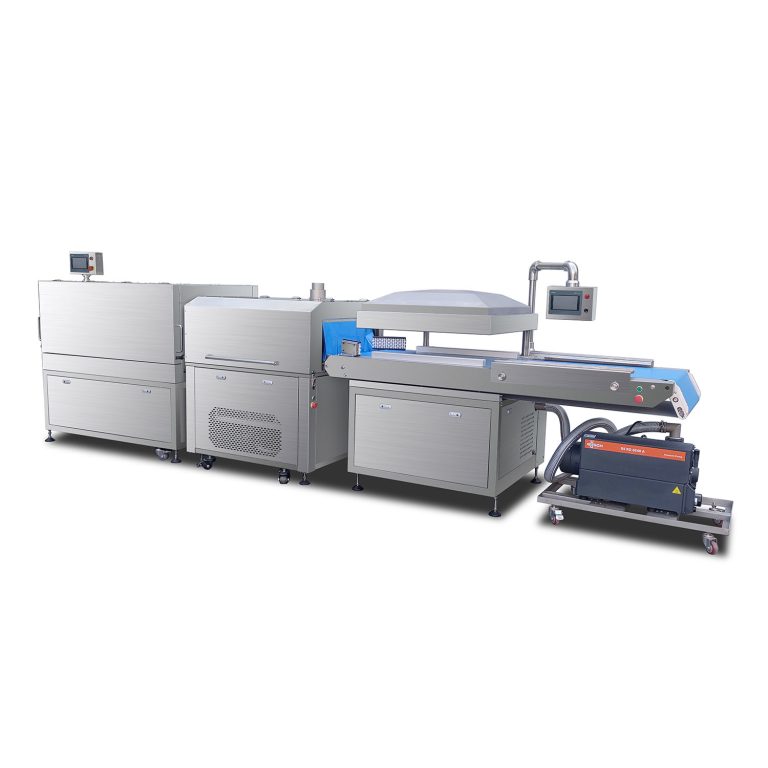
Automated Packaging Line for Meat
Configurable meat packaging line combining vacuum packing, hot-water shrinking, conveying and labeling for the required product and output.
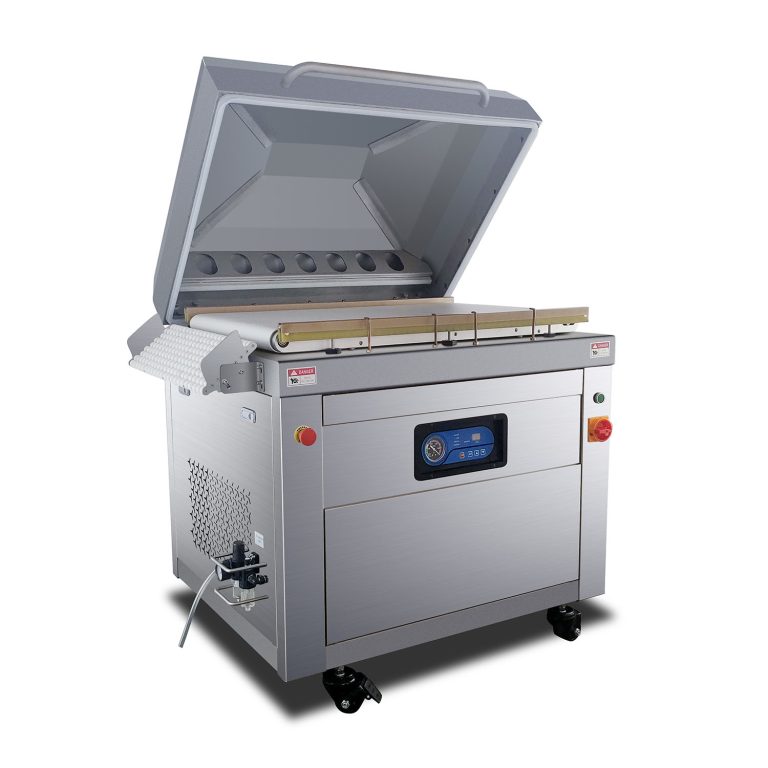
DZQ-850S Chamber Belt Vacuum Packing Machine
Chamber belt vacuum packer for continuous production-line packing with a stainless-steel conveyor. Confirm the selected configuration for your pack and target output.
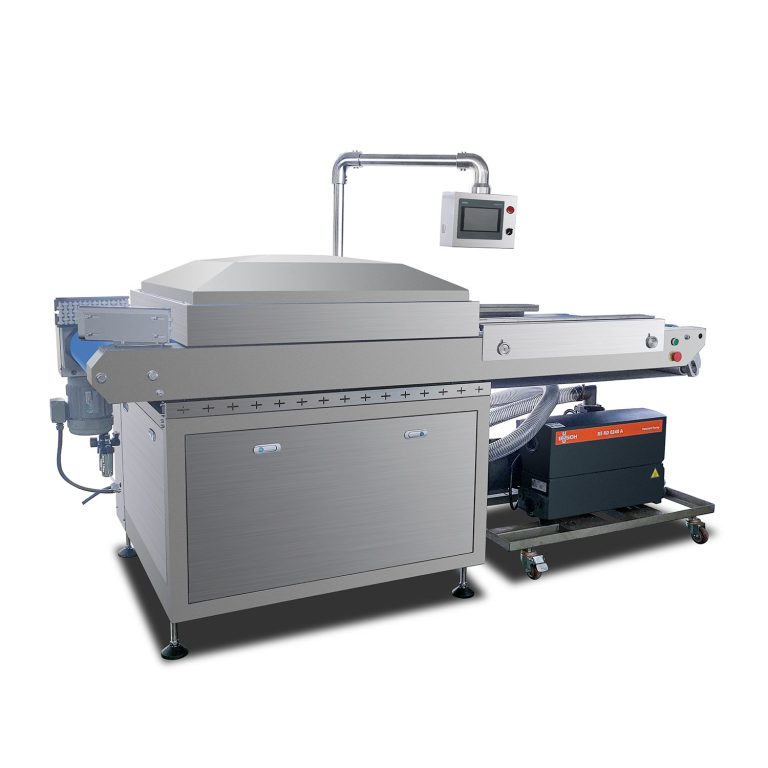
DZQ-800C/1000C Chamber Belt Vacuum Packing Machine
DZQ-800C/1000C Automatic Chamber Belt Vacuum Packaging Machine with 800/1000mm sealing bars, 200m³/h vacuum pump, and stainless steel conveyor. Ideal for meat, food, pharmaceuticals and industrial packaging. CE certified. Factory direct.
Build a Meat Packaging Line Around Your Product and Output
A meat packaging production line is an integrated system that can connect vacuum sealing, hot-water shrinking, wrapping, labeling and conveying around the required package flow. Each station is sized to your throughput so meat, deli and ready-meals move continuously with minimal manual handling.
Also called: integrated meat packaging system, meat packing line, meat vacuum sealing and shrink line. Stations can be added or removed as your line grows.
English version — On-site video of the meat packaging production line
Typical Meat Packaging Line Configuration
One coordinated line configuration — planned around your process.
One integrated line
Vacuum packaging, shrinking, wrapping and labeling can be coordinated around your product flow and handling requirements.
Materials and cleaning
Materials, surfaces and cleaning access are specified for the product, operating environment and sanitation process.
Shelf-ready finish
Shrink tunnel gives vacuum packs a tight glossy film; cling-film overwrap finishes the tray.
Modular stations
Start with vacuum + shrink, add cling-film wrapping or a checkweigher later.
Throughput matched
We size each station to your kg/h or packs/min target, not a fixed template.
Project requirements
Target-market, utility, safety and documentation requirements are reviewed for the selected configuration.
Configure Each Station Around Your Process
Typical per-station parameters for a standard configured line. Exact layout confirmed on your quote.
| Station | Vacuum | Shrink | Cling wrap |
|---|---|---|---|
| Model | DZ-Series | BS-450 | DF-CF1/2/3 |
| Function | Chamber vacuum seal | Water-bath shrink | Tray cling-film wrap |
| Speed | 2–3 cyc/min | 0–300°C bath | 30–60 trays/min |
| Voltage | 220–380V | 380V 9kW | 220V 0.4–0.75kW |
| Material | 304 SS | 304 SS tank | 304 SS frame |
Line layout is customized: tell us your pack size, film and target packs/min and we engineer the station sequence.
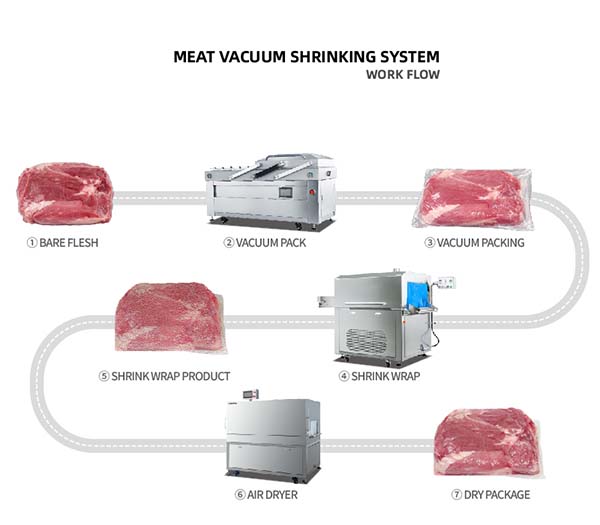
How a Meat Packaging Production Line Works
Four stations, one continuous flow.
Vacuum seal
Trays and pouches are chamber-sealed (optional gas flush) at station 1.
Hot-water shrink
Packs pass through the BS-450 water bath for a tight, glossy film.
Cling-film wrap
Trays are overwrapped inline on the cling-film machine at station 3.
Convey & label
Packs move on the conveyor and are date/code labeled before the shelf.
Applications for Fresh Meat, Poultry and Prepared Foods
Engineered for fresh and processed meat and adjacent products.
Fresh meat trays
Deli & charcuterie
Burgers & patties
Cheese
Ready-meals
Poultry
Seafood
MAP trays
Integrate Vacuum Packaging, Shrinking and Wrapping
A line saves labor and floor space; separate machines suit low volume.
| Factor | Integrated line | Separate machines |
|---|---|---|
| Throughput | Continuous, matched stations | Limited by slowest manual step |
| Labor | One operator oversees flow | Multiple handlers between machines |
| Footprint | Compact single system | Machines spread across floor |
| Price | Higher upfront | Lower per unit |
| Best for | Scale, consistency | Pilot / low volume |
Choose an integrated meat packaging production line when volume and consistency matter; start with separate machines if you are piloting a SKU.
Choose the Right Level of Automation
Size the line to your product and target output.
By product
Fresh trays, deli, MAP or ready-meals — each changes seal, shrink and wrap settings.
By throughput
Tell us packs/min or kg/h; we size chamber, bath speed and wrap rate.
By market
Retail-ready? Add cling-film + date printer. Export? 220/380V and CE/ISO built in.
Complete your packaging line
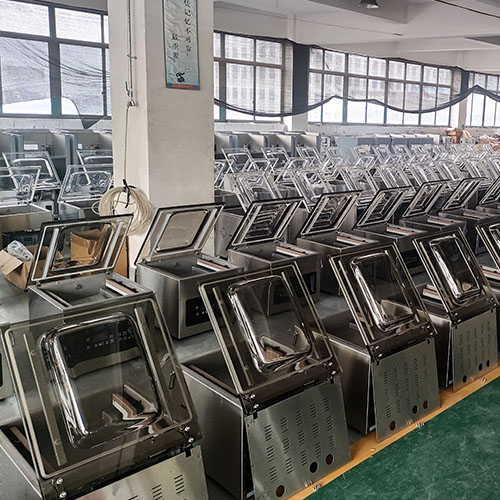
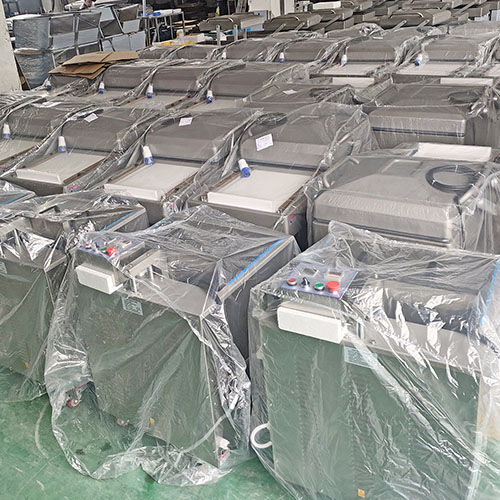
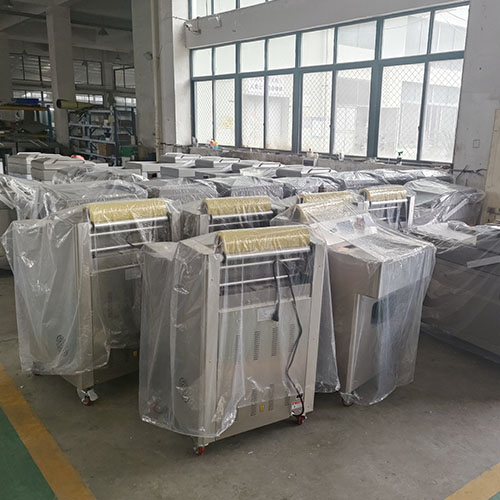
Built for production lines, not showrooms
Required specifications, documentation and acceptance criteria are confirmed for the selected line scope.
Recommended spare parts and service requirements are confirmed for the selected configuration.
Private-label and custom configurations for distributors and integrators.
Frequently Asked Questions
01What equipment can be included in a meat packaging production line?
02How is a line configured for a specific meat product?
03What determines the right level of automation?
04Can existing equipment be integrated?
05What information is needed for a line layout?
06How are vacuum packaging, shrinking and wrapping coordinated?
Get a quote for Meat Packaging Production Line
Tell us your pack size, voltage and target output — we reply with specs and a quote, usually within 24 hours.